
28
2026
-
10
# IBC Tote for Chemicals: A Complete Guide to Safe Storage, Transport & Compliance ## Introduction
An IBC tote for chemicals is a purpose-built intermediate bulk container engineered to store, handle and ship industrial liquids — from mild detergents and fertilizers to corrosive acids, solvents and hazardous materials. Compared with stacks of 200-liter drums, a single 1000-liter chemical IBC tote reduces handling steps, cuts spill risk, and improves loading efficiency, making it the standard unit for chemical distribution, manufacturing and agrochemical supply chains.
However, not every IBC is suitable for chemical duty. Material compatibility, UN certification, sealing performance and temperature limits all determine whether a tote can safely hold a given product. Choosing the wrong unit can lead to material degradation, leakage, regulatory non-compliance and serious safety incidents. This guide explains the main types of chemical IBCs, certification requirements, selection criteria and operational best practices to help buyers and warehouse teams make informed, compliant decisions.
What Is a Chemical-Grade IBC Tote?
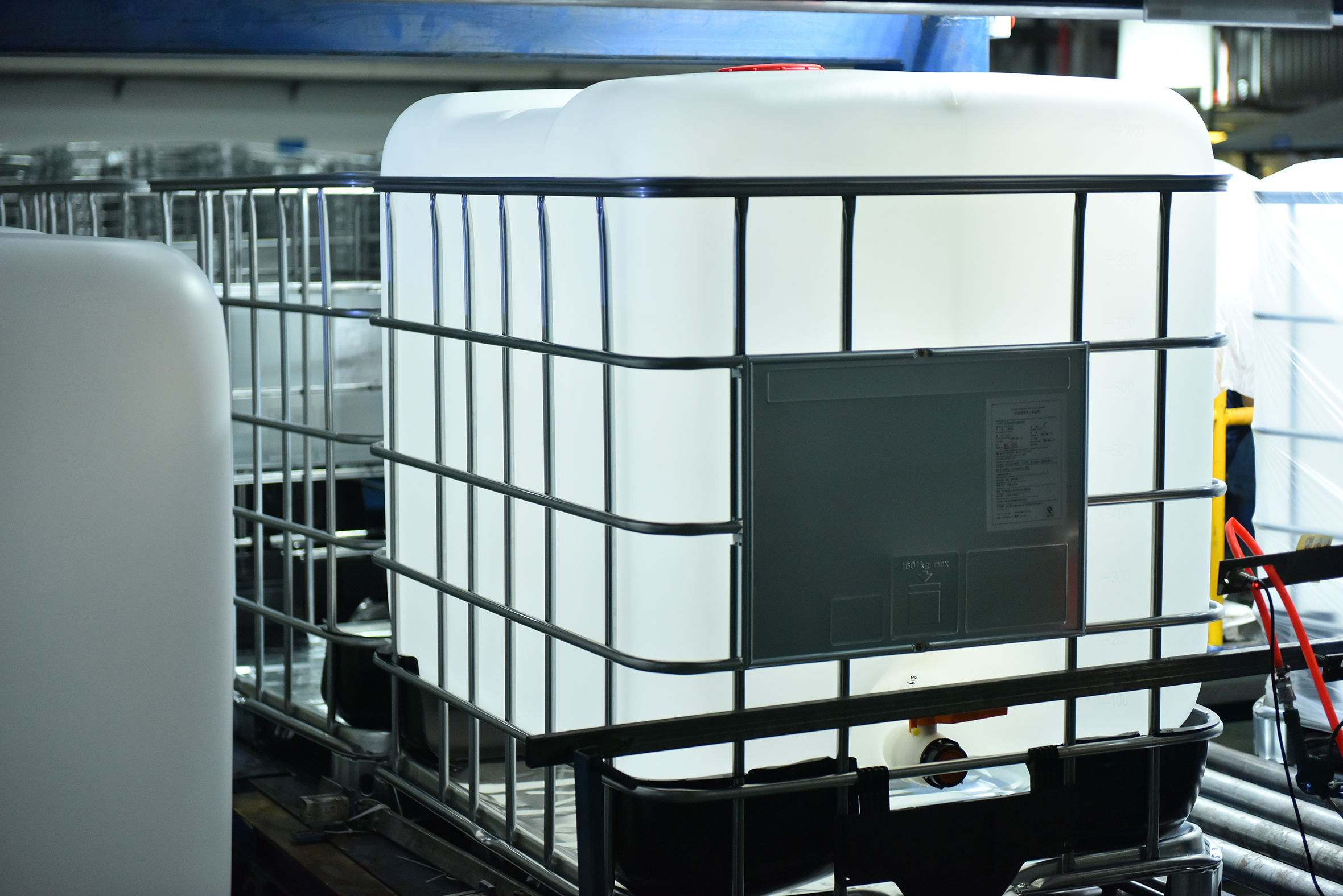
A chemical-grade IBC tote is a rigid bulk packaging unit designed for repeated use with chemical products. It typically consists of an inner liquid-holding bottle, an outer protective cage (for composite plastic models) or an all-metal body, a bottom discharge valve, and a top fill opening. Units intended for hazardous chemicals must pass standardized performance tests and carry official UN marking to be accepted for road, sea and rail transport under international dangerous goods rules.
Standard capacities in the chemical industry are 1000 liters (275 gallons) and 1200 liters, with 600-liter and 500-liter sizes available for smaller-batch specialty chemicals. Unlike general-purpose water or food IBCs, chemical-grade models prioritize chemical resistance, leak-tight construction and certification traceability over low cost.
Main Types of IBC Totes for Chemical Service
Chemical IBCs are categorized primarily by body material, which defines their chemical resistance and safe application range.
1. HDPE Composite IBC Totes
The most widely used chemical IBC is the caged composite model: a blow-molded high-density polyethylene inner bottle supported by a galvanized steel grid cage and a plastic or steel pallet base.
- Best for: dilute acids, alkalis, fertilizers, agrochemicals, detergents, water treatment chemicals and most aqueous solutions at ambient temperature.
- Advantages: broad chemical resistance, light weight, low cost, widely available, easy to clean and recondition.
- Limitations: continuous service temperature is roughly 49–60°C; not suitable for strong solvents, Class I flammable liquids or long-term contact with highly concentrated oxidizers; subject to UV degradation if stored outdoors long-term.
2. Stainless Steel IBC Totes (304 / 316L)
All-stainless steel IBCs are used for higher-value, more demanding chemical applications. 316L grade offers superior corrosion resistance versus 304, especially with chlorides and acidic products.
- Best for: solvents, specialty chemicals, pharmaceutical intermediates, food-grade chemicals, hot-fill products and applications requiring high purity or steam cleaning.
- Advantages: wide temperature range, pressure-rated designs available, long service life, compatible with many organic chemicals, better fire performance than plastic.
- Limitations: higher upfront cost; 304 grade is vulnerable to pitting from chloride-bearing chemicals such as hydrochloric acid and bleach.
3. Carbon Steel IBC Totes
Carbon steel units are heavy-duty, economical options for non-corrosive, non-aqueous industrial liquids.
- Best for: petroleum products, oils, lubricants, and concentrated sulfuric acid (where the acid forms a passivating layer on steel).
- Advantages: high structural strength, suitable for heavy industrial environments, lower cost than stainless steel for compatible products.
- Limitations: prone to rust with aqueous or acidic products; internal coatings or linings are required for many chemical uses.
Quick Material Comparison
表格
| IBC Type | Primary Chemical Use Case | Temperature Range | Typical Packing Group Rating |
|---|---|---|---|
| HDPE composite | Acids, bases, agrochemicals, aqueous solutions | Ambient to ~60°C | II / III |
| 304 Stainless | Solvents, mild acids, food chemicals | Wide, hot-fill capable | II / III |
| 316L Stainless | Corrosive chemicals, chlorides, pharma-grade | Wide, high-purity | II / III |
| Carbon steel | Oils, fuels, concentrated sulfuric | Wide | II / III |
UN Certification & Regulatory Compliance
For any IBC tote used to transport hazardous chemicals, UN certification is non-negotiable. UN-marked IBCs have passed design qualification tests including drop, leakproofness, hydraulic pressure and stacking tests, and are rated for a specific packing group (PG II or PG III for liquid chemicals)GovInfo.
Key certification facts
- Packing Group limits: Standard IBCs are not authorized for Packing Group I liquid dangerous goods; only PG II and PG III liquids are permitted under most regulationseCFR.
- Periodic inspection: UN IBCs for liquid dangerous goods require leak testing and formal inspection at least every 30 months by an approved facility. Lightweight and reconditioned units may need more frequent checksTransport ....
- Marking: A valid UN IBC displays a permanent marking code showing the UN number, container type, packing group, year of manufacture, test date and maximum gross mass.
- Regional rules: In North America, 49 CFR DOT regulations apply; in Europe and international shipping, ADR / IMDG / RID rules govern chemical transport.
Always verify that the IBC’s UN rating matches the packing group and hazard class of the chemical being shipped. Using a general-purpose tote for regulated hazardous material can result in rejected shipments, fines and serious liability.
How to Select the Right Chemical IBC Tote
Choosing the correct unit requires evaluating more than just capacity. Use the following criteria in order of priority:
1. Chemical compatibility first
Confirm body and seal material against the product’s Safety Data Sheet (SDS). Concentration and temperature strongly affect compatibility — a material safe at 20°C may fail at 40°C.
- For most mineral acids and caustic solutions: HDPE with EPDM or PTFE seals is the standard choice.
- For solvents, fuels and aromatic hydrocarbons: stainless steel with Viton/FKM seals is required; standard HDPE is not recommended for long-term storage.
- For chloride-bearing chemicals: HDPE is preferred over stainless steel to avoid pitting corrosion.
2. Capacity and gross weight
Match the tote volume to batch size and logistics constraints. A full 1000 L chemical tote can exceed 1500 kg gross weight depending on liquid density, so ensure forklift capacity, floor loading and pallet racking are rated accordingly.
3. Valve and fitting configuration
Select a discharge valve (ball or butterfly) and outlet connection compatible with your existing hoses, pumps and dispensing stations. For chemical service, ball valves generally offer better sealing and are easier to flush between products. Seal material must match the chemical — never assume a standard EPDM seal works for all products.
4. Reuse and reconditioning plan
If you intend to reuse or recondition the tote, choose a design with replaceable valves, gaskets and caps. HDPE composite totes are the most economical to recondition for non-hazardous and PG III chemicals.
Safe Storage & Handling Best Practices
Even the best chemical IBC tote creates risk if stored or handled incorrectly. Follow these industrial best practices:
- Secondary containment: Place chemical IBCs on spill containment pallets or within a bunded area capable of holding at least 110% of the largest container’s volume.
- Ventilation: Store volatile or fuming chemicals in well-ventilated areas to prevent vapor buildup.
- Temperature control: Keep HDPE totes away from direct heat sources and prolonged UV exposure. Avoid freezing conditions for aqueous products that may expand and crack the bottle.
- Regular inspection: Perform visual checks before each use for cracks, bulging, discoloration, valve stiffness and leakage. Schedule formal requalification on the required cycle.
- Proper lifting: Always move full totes with a rated forklift or pallet jack from the base; never lift by the top cage or valve.
- PPE and training: Require chemical-resistant gloves, eye protection and appropriate PPE during dispensing. Ensure personnel are trained on spill response and SDS information.
Common Industry Applications
Chemical IBC totes serve across multiple sectors, each with specific requirements:
- Agrochemicals: HDPE UN-certified totes for herbicides, insecticides and liquid fertilizers.
- Water treatment: HDPE totes for coagulants, flocculants, acids and caustic soda.
- Specialty chemicals: Stainless steel IBCs for solvents, monomers and high-purity formulations.
- Cleaning products: HDPE totes for detergents, surfactants and industrial cleaners.
- Petrochemicals: Carbon steel or stainless IBCs for oils, lubricants and base fluids.
Frequently Asked Questions
Can any IBC tote be used for chemicals?
No. General-purpose or food-grade IBCs may lack the correct UN rating, seal material and chemical resistance. Always use a tote specified and certified for the intended chemical.
What UN rating do I need for a chemical IBC tote?
For liquid hazardous chemicals, you typically need a UN-marked IBC rated for Packing Group II or III, matching the classification of your product on the SDS and shipping documentation.
Is HDPE safe for storing acids?
HDPE provides good resistance to most dilute and many concentrated mineral acids at room temperature, including hydrochloric acid and sulfuric acid at moderate concentrations. Always verify against a compatibility chart and the product SDS.
How long does a chemical IBC tote last?
With proper maintenance and compatible chemicals, HDPE composite totes typically last 5–10 years; stainless steel IBCs can last decades. Aggressive chemicals, UV exposure and temperature extremes shorten service life.
Can I reuse a chemical IBC tote for a different product?
Reuse is possible only after thorough cleaning and decontamination, and only if the new product is compatible with the tote material and does not require a higher UN rating. Maintain a clear content history for every unit.
Conclusion
Selecting the right IBC tote for chemicals is a balance of material science, regulatory compliance and operational practicality. Start with the chemical’s SDS and hazard classification, match the body and seal material to compatibility requirements, confirm UN certification and packing group rating, then align capacity and fittings with your facility’s workflow. When paired with proper storage, regular inspection and trained handling, a correctly specified chemical IBC tote delivers safe, cost-effective bulk packaging across many transport and reuse cycles.
ibc tote for chemicals,UN certified chemical ibc tote,hdpe ibc tote for chemical storage,stainless steel chemical ibc tank,1000l chemical ibc container,275 gallon chemical tote
CONTACT US
-
Address: No. 5, Torch Avenue, Sino- Europe Industrial Park of Hebei Province, (Zhongjie Huanghua City)
-
Subsidiary Company Address :Workshop 10, Zhongjie Industrial Venture Base, Zhongjie High-Tech Zone, Huanghua, Cangzhou, Hebei Province, China
Tel:400-057-0080
Email:shijiheng@czssjh.com
Tel:0317-5601506
-
Copyright © Hebei Shijiheng Plastics Co.,Ltd.
LINK
-
► About us
► Products
► Partner
► News
► Contact us
PRODUCTS


