
13
2026
-
11
Some Paints Will Dissolve Your IBC Tote—Here’s the Solvent Line You Can’t Cross
Some Paints Will Dissolve Your IBC Tote—Here’s the Solvent Line You Can’t Cross
The phrase “ibc tote for paint” implies a single category. Paint is not a single category. A water-based latex and a xylene-thinned epoxy are both paints, and one of them will sit quietly in an HDPE tote for years while the other softens the bottle wall, permeates the polymer, and turns a storage decision into a containment event.
The mistake in paint IBC procurement is treating “paint compatibility” as one answer. It is a solvent-by-solvent decision, and the line between acceptable and unacceptable runs through the middle of the paint catalogue. This article is not about cleaning validation, food contact, or fuel storage. It is about the three paint-specific variables that decide whether an IBC tote is a storage asset or a slow failure: solvent class, skinning control, and electrostatic classification.
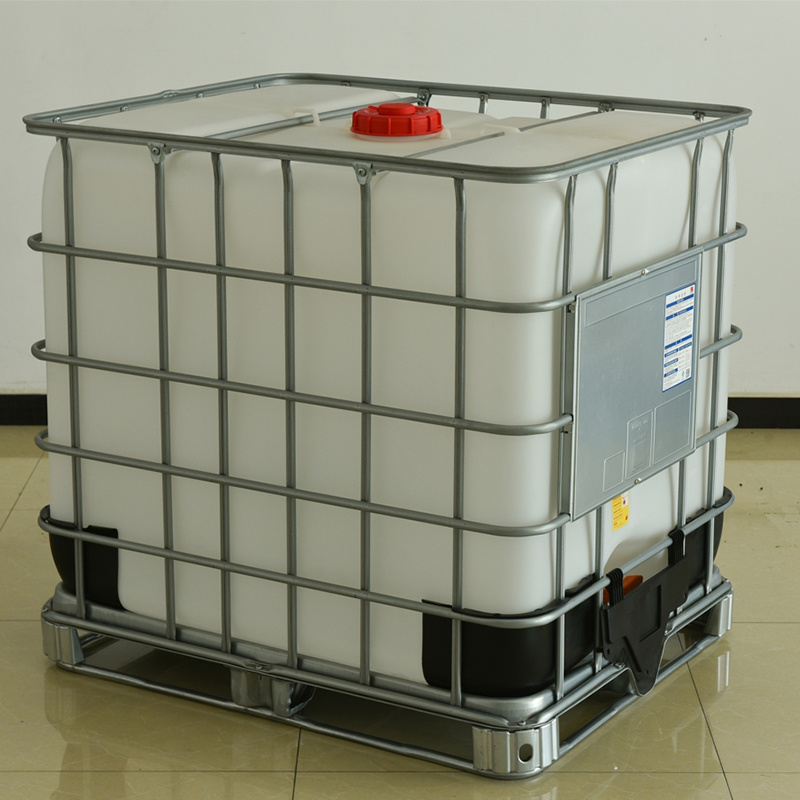
The Solvent Line: What HDPE Accepts and What It Refuses
HDPE is chemically resistant to virtually all water-based formulations and most solvent-based coatings. Latex paints, acrylics, waterborne stains, and the majority of architectural coatings are a comfortable fit. The bottle does not care about pigment, filler, or rheology modifier. It cares about the solvent.
The incompatibility list is where the paint specification has to get specific. HDPE has limited or no compatibility with aromatic hydrocarbons—benzene, toluene, and xylene—which cause significant swelling and softening, especially at elevated temperatures. Ketones and esters—acetone, MEK, ethyl acetate—show fair to poor compatibility, with long-term storage causing permeation and softening even where short-term exposure appears acceptable. Chlorinated solvents such as methylene chloride and trichloroethylene aggressively swell and dissolve HDPE. And terpene-based solvents—turpentine, pine oil, d-limonene—are more aggressive toward HDPE than many paint formulators assume.
The practical consequence is that a solventborne coating is not automatically an IBC coating. A xylene-reduced epoxy or a MEK-containing lacquer is a metal IBC or a lined-container decision, not an HDPE decision. The compatibility check must be run against the specific solvent or solvent blend in the formulation, not against the generic label “solvent-based paint.” Compatibility charts assume room temperature and a stated concentration; warmer fills and stronger concentrations shift the rating in the wrong direction.
Skinning Is Not Cosmetic—It Is the Seal Specification
Paint fails in storage in a way that water and fuel do not: it forms a skin when exposed to air. That skin ruins product quality, and it is driven by the same air exchange that carries solvent vapor out of the container. Solvent-based coatings lose their solvent component when the closure is not airtight, changing viscosity and application properties.
An IBC tote for paint therefore lives or dies on its closure system, not its bottle capacity. The specification that matters is a sealed fill cap and a valve that holds an airtight seal across storage and transport, with replaceable gaskets maintained as a scheduled item rather than a breakdown repair. A standard cam-lock or a worn butterfly valve seat is a skinning vector on a solventborne product and a viscosity-drift vector on any coating that relies on a solvent balance.
This is also where the gasket compound enters the paint decision, but for a different reason than in fuel or oil service. The gasket must be compatible with the solvent in the paint, not merely with “paint” as a category. A gasket that swells in xylene or softens in MEK produces the same slow weep described in oil service, except the leaking fluid is a coating that skins on contact with air and is far harder to clean from a containment floor.
The Static Question That Splits Plastic and Metal IBCs
Paint and coatings sit in the same flammable-liquid handling space as solvents, and that triggers an electrostatic classification requirement that many paint buyers never see on a datasheet.
For metal IBCs, the earthing resistance to the loading system must be not greater than 10 Ω. For plastic containers, the allowable earth resistance is far higher—1 MΩ—because the container itself is insulating and cannot be treated as a conductive path. That does not mean a standard HDPE paint tote is automatically safe for flammable solvents. It means the electrostatic strategy for plastic IBCs depends on electrostatically protected construction: a conductive inner earth contact, a conductive cage or wrap, or an equivalent design that suppresses brush discharges from the inner wall.
The specification line is therefore not “grounding lug included.” It is the electrostatic classification of the tote matched to the flash point and conductivity of the paint’s solvent system. A waterborne latex does not carry the same static profile as a solventborne coating reduced with a low-flash-point solvent. A tote that is perfectly adequate for latex and completely wrong for a solventborne product should not be selected by the same procurement line item.
The Compliance Layer: Capacity and Spacing Are Not Optional
Paint IBCs used for flammable or combustible liquids fall under storage rules that are separate from the UN transport marking. The transport marking says the container is authorized to move the product; it does not authorize the storage arrangement.
The spacing rule is concrete: containers, IBCs, and portable tanks in unprotected liquid storage areas shall not be stored closer than 36 inches (915 mm) to the nearest beam, chord, girder, or other roof or ceiling member. A paint IBC plan that stacks totes to the roofline in a warehouse violates the spacing requirement before the first fire-code inspection. Capacity limits are site-specific—one hazardous-waste storage plan caps a bay at four IBCs and 1,320 gallons total—but the principle is general: the aggregate gallon count and the physical arrangement are part of the storage approval, not an afterthought.
The final compliance distinction is the one paint buyers most often miss. A UN-marked IBC is a transport container. Storage approval depends on the local fire code, the liquid class, the building arrangement, and the site’s aggregate quantity. The IBC that is legal on the truck may not be legal in the paint aisle.
The Paint IBC Specification That Holds
A paint IBC tote is not a generic chemical tote. It is a solvent-class–matched vessel with a skinning-control seal and an electrostatic classification.
Write the solvent blend, not the product category. Waterborne and most solventborne coatings are HDPE-compatible; aromatic, ketone, ester, chlorinated, and terpene solvents move the decision to metal, lined, or electrostatically protected construction. Specify an airtight closure system with a gasket compound matched to the solvent, and treat gasket replacement as scheduled maintenance. Match the electrostatic classification to the solvent’s flash point and conductivity, not to the word “paint.” And verify the storage arrangement against the spacing and capacity rules before the tote enters the building.
The paint tote that survives is not the one with the largest capacity or the lowest price per gallon. It is the one whose solvent list was checked before the bottle was chosen—and whose seal, ground path, and storage position were specified before the first fill. Read the solvent, not the label.
ibc tote for paint,IBC tote for coatings,paint IBC tote gasket,latex paint IBC tote,sealed IBC tote paint skinning,HDPE IBC tote for paint
last page
CONTACT US
-
Address: No. 5, Torch Avenue, Sino- Europe Industrial Park of Hebei Province, (Zhongjie Huanghua City)
-
Subsidiary Company Address :Workshop 10, Zhongjie Industrial Venture Base, Zhongjie High-Tech Zone, Huanghua, Cangzhou, Hebei Province, China
Tel:400-057-0080
Email:shijiheng@czssjh.com
Tel:0317-5601506
-
Copyright © Hebei Shijiheng Plastics Co.,Ltd.
LINK
-
► About us
► Products
► Partner
► News
► Contact us
PRODUCTS


